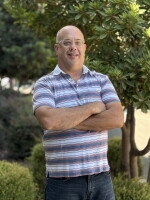
FRESNO COUNTY, Calif. – Coalinga Mayor Nathan Vosburg is a registered Republican who describes himself as “a very conservative person.”
Vosburg also happens to be a strong proponent of Measure S, the half-cent transportation tax that goes before Fresno County voters in November as a successor to Measure C.
So when Vosburg heard Fresno County Board of Supervisors Chairman Garry Bredefeld describe Measure S backers as “radical leftists,” Vosberg said he couldn’t help but shake his head and roll his eyes.
“It’s ridiculous,” Vosburg said. “Absolutely ridiculous."
Vosburg isn’t the only Republican mayor in Fresno County who supports the sales tax. That group also includes Fresno Mayor Jerry Dyer, Clovis Mayor Vong Mouanoutoua, Mendota Mayor Victor Martinez and Parlier Mayor Alma Beltran.
“It’s not based on [party affiliation] whatsoever,” Vosburg said about his support of Measure S, which is opposed by three Republican county supervisors.
“I think a lot of what the county doesn't like is because it gives more money to the cities, to the individual cities, to actually fix what needs to be fixed first, rather than expansion,” Vosberg added.
During the political and legal battle over the crafting of Measure S and its inclusion on the November ballot, detractors often pointed to what they consider to be undue influence of environmental justice groups like Leadership Counsel for Justice & Accountability, and philanthropic organizations like the Central Valley Community Foundation.

But Republican mayors on the Fresno Council of Governments (COG) Policy Board also exerted influence over Measure S leaving the starting gate.
Mouanoutoua, who is running for county supervisor against fellow Clovis council member Diane Pearce, said the measure’s most strident opponents often misdirect their criticisms.
“We can all debate, but tell me what you don't like about it – not who you don't like,” Mouanoutoua said. “That's your personal problem.”
More money for cities
If passed by a majority of the county electorate, Measure S is projected to generate $7.4 billion until it expires in 2057. The proposed measure directs a much greater portion of revenues – 65% – to existing neighborhood roads.
When compared to Measure C, which sunsets in June 2027, cities appear to be the big winners under Measure S.
For example, Fresno (which accounts for roughly 56% of the population of Fresno County) received nearly $226 million from Measure C between 2007-27. Under Measure S, which runs for 30 years, Fresno would get $2.26 billion. (This includes funding for local roads and public transit.)
Clovis received $48.8 million during the last 20 years of Measure C. Under Measure S, the county’s second-largest city is projected for $542 million.
Smaller Fresno County cities would also share in the bounty.
For example, Coalinga’s transportation tax revenues are estimated to increase from $9.2 million under Measure C to $81.3 million under Measure S. And Mendota’s portion jumps from $6.9 million under Measure C to an estimated $61.4 million under Measure S.
“For too long our cities have been forgotten with [Measure C] shorting our cities a lot with funding,” said Martinez, the mayor of Mendota. “That explains the reason why these roads in our communities are so bad.”

Cracked pavement, unsafe intersections
The poor condition of local roads is especially noticeable in the west side communities of Mendota and Firebaugh.
In downtown Mendota, Martinez takes visitors to Naples Street, a side road lined with warehouses and homes one block off the town’s main thoroughfare of Oller Street – which is also Highway 180.
Naples Street is littered with potholes, some of which have been crudely patched. In other places, the pavement has been worn down to gravel.
The city’s Pavement Condition Index score stands at 36, according to Martinez. On the 1-to-100 scale used to measure surface condition of roadways, a score of 36 is considered “very poor.”
“This road has probably never seen any enhancement since it was constructed 40 or 50 years ago,” Martinez said.

In Firebaugh, Mayor Freddy Valdez takes visitors to residential Yip Street, where the pavement is replete with cracks and potholes.
Less than a block away and closer to Highway 33, the road is noticeably smoother thanks to a Caltrans-funded highway beautification project. But here, the spiderwebbed pavement resembles the leathery scales of an alligator.
“These are the types of streets that we couldn't get with the previous Measure C because we really had to focus on other areas,” Valdez said. “But residents don’t want to hear that.”
Besides repairing local roads, Valdez is hopeful Measure S can reduce traffic and improve safety at one of Firebaugh’s busiest intersections. Measure S sets aside 65% for this purpose compared to 34.6% under Measure C.
Coming west from Fresno and Madera, residents and truckers typically enter Firebaugh via Avenue 7 1⁄2. After crossing the San Joaquin River, motorists are greeted by a four-way stop sign at P Street, where an intermediate school sits on one corner across from a senior housing facility.
I brought out a bunch of experts to help us to see if building an underpass, building an overpass, building a calming circle are all the answers, and if any of those will work. But guess what? You need funds.Firebaugh Mayor Freddy Valdez
During commute hours, traffic backs up so far that many residents avoid the intersection entirely. Much of the traffic isn’t local, Valdez said. Rather, it’s caused by commerce and farming trucks using Firebaugh as a shortcut to Interstate 5 and Highway 152 headed to and from the Bay Area.
“People traveling through Firebaugh save 27 minutes to get to the Bay Area compared to taking 152” through Los Banos, Valdez said.
While Measure C has allowed Firebaugh to repave the notorious intersection and repaint crosswalks near the school, true safety improvements have remained out of reach.
“I brought out a bunch of experts to help us to see if building an underpass, building an overpass, building a calming circle are all the answers, and [if] any of those will work,” Valdez said. “But guess what? You need funds.”
Firebaugh would be allotted more than eight times as much funding under Measure S when compared to the last version of Measure C – money Valdez said could be used to leverage state and federal matching funds to pay for such a project.
“That’s why Measure S is so important to small rural communities,” he said.
Opposition to Measure S
Support for Measure S isn’t unanimous among rural Fresno County mayors, or Republican mayors at that.
Matthew Tuttle belongs to both of those groups. The Reedley mayor was one of four Fresno County mayors who voted against the measure when it went before the Fresno COG board, compared to 11 “yes” votes.
Even though Reedley would receive significantly more money for local roads, Tuttle has several concerns.
Chief among them is the severe reduction in regional projects funded by the measure – 5% under Measure S compared to 30.4% under Measure C – which he worries would negatively impact the county’s ability to improve safety on connector roads like Reed Avenue and Manning Avenue that residents use every day.
“Reedley is a bedroom community. The majority of our public travels outside the city of Reedley on a daily basis,” Tuttle explained. “That regional connectivity is super important, not just to Reedley, but it should be important to everybody. … If Measure S is going to stand for safety, then safety is a prime element of regional connectivity.”

Tuttle also criticized Measure S for its 30-year lifespan – 10 years longer than the two versions of Measure C approved by voters.
He argued the use of the term “where feasible” with regard to bike lanes and safe routes to schools projects will leave cities vulnerable to litigation.
And he called a provision that required the county to improve roads in disadvantaged communities before tackling roads in more affluent areas “too prescriptive.”
If county voters reject Measure S, cities like Reedley won’t have any transportation tax funding to fix local roads until at least the next election cycle. But that’s a chance the mayor is willing to take.
“No measure is better than a flawed measure – especially for 30 years,” Tuttle said. “I would much rather go back to the negotiation table because we can do better.”