

This story was originally published by EdSource.
In late February, students at Coarsegold Elementary School in Madera County roamed around a classroom that’s like no other on campus.
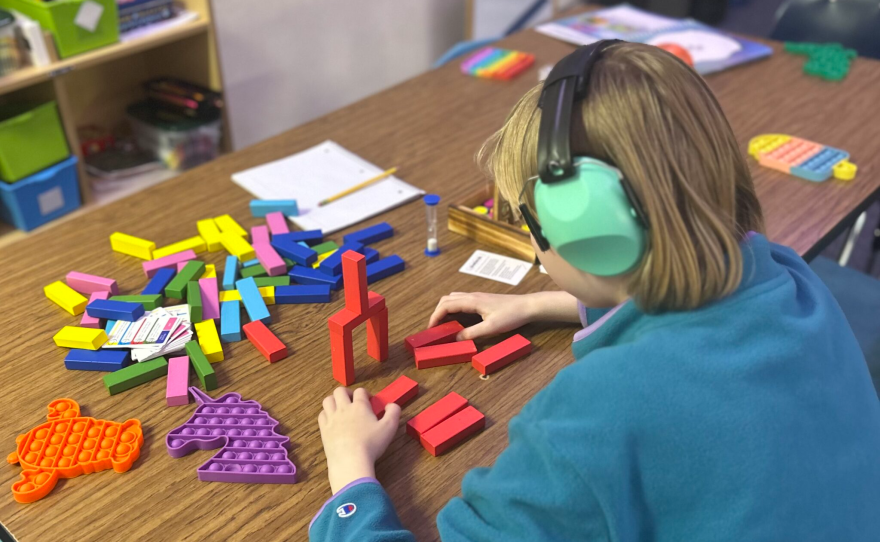
One student jumped on a mini-trampoline, releasing pent-up energy. Others settled into a rocking chair or on beanbags to read books. Another wore headphones as she constructed blocks.
This is Coarsegold’s Zen Den. Designed to help students manage their emotions, the calming space is a small part of California’s multi-year, $4 billion effort to turn thousands of high-poverty campuses into community schools.
Community schools are not a new concept. The model is defined by a few key principles and provides services not normally found at a traditional school, including health care, mental health support and food pantries. These schools emphasize the “whole child approach,” which aims to meet a child’s academic, physical, mental and social and emotional needs. Educators work with families and local organizations to figure out how to best support students and communities.
Based on early signs of success, Gov. Gavin Newsom has proposed permanent funding for community schools. If approved by the Legislature, another $1 billion each year would go toward expanding and maintaining the model.
As legislators consider Newsom’s proposal, they must weigh whether to enshrine it into the state’s funding formula and, if so, whether $1 billion is enough to grow and sustain the model while ensuring accountability.
Nearly 2,500 schools, or about 25% of California campuses, have received the state’s community school grant funding since 2021. Under the governor’s proposal, an additional 3,700 schools would be eligible for funding each year. The Legislative Analyst’s Office, the state’s nonpartisan fiscal and policy adviser, has raised concerns about the proposal, including how the state will afford an ongoing funding stream if the number of community schools nearly triples.



A pandemic push to fund community schools
If lawmakers do approve the governor’s proposal, California would join Maryland and New York as states that fund community schools through their state funding formulas. But it’s taken decades to get to this point.
During the Civil Rights Movement in the 1960s, some schools in Oakland Unified School District focused on the community school approach, said Marisa Saunders, the associate director of research for the UCLA Center for Community Schooling. Whether called a community school or not, by 2014, schools using the whole-child, community-engaged approach had grown in California and nationwide.
By 2020, 39 states — not yet including California — funded community schools, according to the National Education Association, the union for public school teachers and educators.
The California Teachers Association and local unions had long advocated for California to fund the model, too. The state Legislature decided to do so in 2021, largely because the Covid-19 pandemic disrupted learning and exacerbated many issues students faced.
Since then, schools have used the money to help remove barriers that prevent a student from attending or thriving at school.
Fresno Unified’s 29 community schools provide food, backpacks, laundry service, eyewear and closets of clothes, hygiene products and other necessities.

Schools also enlist community members and organizations to provide resources for students. Chowchilla High Union School District in Madera County, for instance, obtained 20 vouchers for barbershops and hair salons for students in need.
In other community schools across Madera County, in Chawanakee Unified’s North Fork Elementary School, where nearly 15% of the student population is American Indian, there are tribal lessons on the traditional way to weave a basket to foster a sense of belonging among Native American students. Yosemite Unified has purchased a van for Coarsegold Elementary, located in the rural mountain foothills, to bring families and students to after-school events.
Because of these programs, students are motivated to come to school and feel welcomed and supported once there, educators say, leading to better attendance, fewer discipline problems and academic gains.
“They feel more connected,” said Anna Maier, senior policy adviser and researcher for the Learning Policy Institute, a nonprofit research organization that has studied community schools and student outcomes.
The data shows some improvement
And there is some evidence to back up those claims, according to the institute. It compared data from state-funded community schools to similar, neighboring schools without the funding. Looking at student outcomes from the 2018–19 school year to 2023–24, the institute found:
- Chronic absenteeism at community schools declined, on average, 30% more than at comparison schools.
- Suspension rates decreased by an average of 15% while there were slight increases at comparison schools.
It also found that students at community schools improved their English scores, equaling 36 additional days of learning, and math scores, equating to 43 additional days of learning, more than at comparison schools.
Gains were greater at elementary schools, schools in the first round of grant funding and among specific student groups, such as Black students and English learners.
These signs of success are driving the governor’s push to make community school funding permanent, said Linda Darling-Hammond, president of the State Board of Education and an adviser to the governor. She was the founding president of the Learning Policy Institute.
Questions remain about the proposal

Under the $1 billion proposal, most of California’s schools would qualify for funding — as many as 6,200 schools.
The Legislative Analyst’s Office (LAO) estimates that the $1 billion a year will not be enough to fund all eligible schools over time, especially once the current grant funding expires.
The proposal introduces accountability measures but includes few requirements for new community schools until 2029.
For example, schools would need to self-certify that they’re implementing the model. But adopting the model often requires fundamental changes in schools, including engaging the community in decision-making. Sometimes, school or district staff are resistant to changing long-held practices, the LAO noted.
The proposed legislation also establishes an accreditation process. Schools would need to meet requirements to continue receiving community school funding. However, the accreditation process has not yet been defined.
Pointing to costs, unclear guidelines and other questions about implementation and accountability, the LAO recommends a continued grant-funded program for additional rounds of community schools, not funding the model as part of the state’s funding formula.
But Darling-Hammond, the governor’s adviser, said building community schools into the state formula is how California would ensure their sustainability.
“We’ve had a history in California of all kinds of wonderful programs that have been successful, that are funded with one-time funding,” she said. “And they come and they go.”